Humanoid Toolkit#
Humanoid Toolkit is an intuitive, easy-to-use software stack designed to streamline the development of humanoid products and applications on Intel platforms. The toolkit provides a comprehensive environment for developing, testing, and optimizing humanoid software and algorithms. It includes the necessary software frameworks, libraries, tools, best-known configurations (BKC), tutorials, and example code for AI solution development.
Humanoid Toolkit includes the following features:
Comprehensive software platform from BSP and acceleration libraries to reference demos, with documentation and developer tutorials;
Real-time BKC, Linux real-time kernel and optimized EtherCAT;
Traditional vision and motion planning acceleration on CPU, Reinforcement/Imitation Learning-based manipulation, AI-based vision & LLM/VLM acceleration on iGPU & NPU;
Typical workflows and examples including ACT/DP-based manipulation, LLM task planning, Pick & Place, ORB-SLAM3, etc.
Software Architecture#
The following diagram shows the high-level Humanoid Toolkit software architecture:
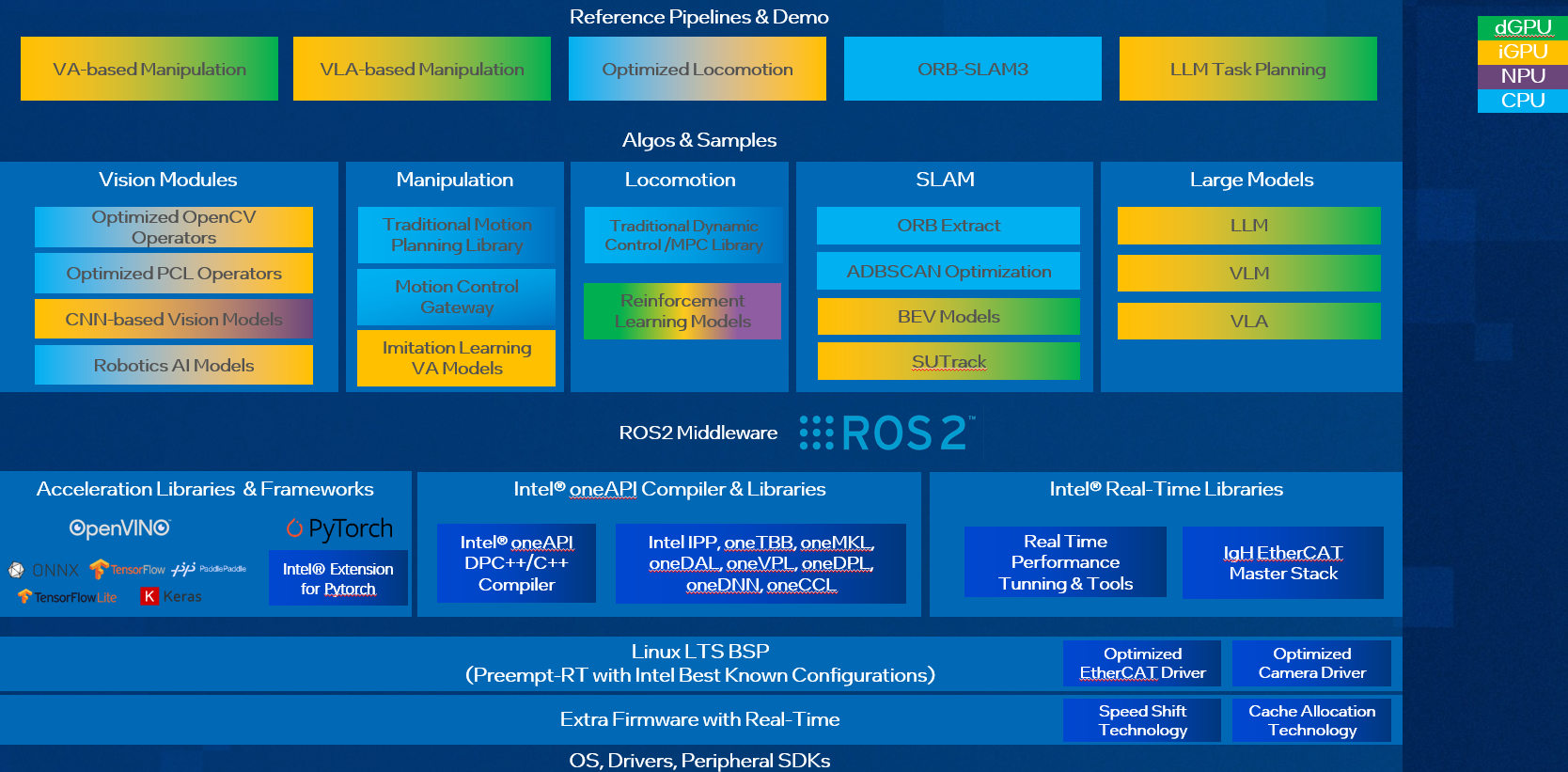
This software architecture is designed to power Humanoid Toolkit systems by integrating computer vision, AI-driven manipulation, locomotion, SLAM, and large models into a unified framework. Built on ROS2 middleware, it takes advantage of Intel’s CPU, iGPU, dGPU, and NPU to optimize performance for robotics and AI applications. The stack includes high-performance AI frameworks, real-time libraries, and system-level optimizations, making it a comprehensive solution for humanoid products.
At the highest level, the architecture is structured around key reference pipelines and demos that demonstrate its core capabilities. These include Vision Servo, which enhances robotic perception using AI-powered vision modules, and ACT-based Manipulation, which applies reinforcement learning and imitation learning to improve robotic grasping and movement. Optimized Locomotion leverages traditional control algorithms like MPC (Model Predictive Control) and LQR (Linear Quadratic Regulator), alongside reinforcement learning models for adaptive motion. Additionally, the ORB-SLAM3 pipeline focuses on real-time simultaneous localization and mapping, while LLM Task Planning integrates large language models for intelligent task execution.
Beneath these pipelines, the software stack includes specialized AI and robotics modules. The vision module supports CNN-based models, OpenCV, and PCL operators for optimized perception, enabling robots to interpret their surroundings efficiently. The manipulation module combines traditional motion planning with AI-driven control, allowing robots to execute complex movements. For locomotion, the system blends classic control techniques with reinforcement learning models, ensuring smooth and adaptive movement. Meanwhile, SLAM components such as GPU ORB extraction and ADBSCAN optimization enhance mapping accuracy, and BEV (Bird’s Eye View) models contribute to improved spatial awareness. The large model module supports LLMs, Vision-Language Models (VLM), and Vision-Language-Action Models (VLA), enabling advanced reasoning and decision-making capabilities.
At the core of the system is ROS2 middleware and acceleration frameworks, which provide a standardized framework for robotics development. The architecture is further enhanced by Intel’s AI acceleration libraries, including OpenVINO™ for deep learning inference, Intel® LLM Library for PyTorch (IPEX-LLM) for optimized large model execution, and compatibility with TensorFlow*, PyTorch*, and ONNX*. The Intel® oneAPI DPC++/C++ Compiler and libraries offer high-performance computing capabilities, leveraging oneMKL for mathematical operations, oneDNN for deep learning, and oneTBB for parallel processing. Additionally, Intel’s real-time libraries ensure low-latency execution, with tools for performance tuning and EtherCAT-based industrial communication.
To ensure seamless integration with robotic hardware, the toolkit runs on a real-time optimized Linux board support package. It includes support for optimized EtherCAT and camera drivers, along with Intel-specific features such as Speed Shift Technology and Cache Allocation to enhance power efficiency and performance. These system-level enhancements allow the software stack to deliver high responsiveness, making it suitable for real-time robotics applications.
Overall, the Humanoid Toolkit provides a highly optimized, AI-driven framework for robotics and humanoid applications, combining computer vision, motion planning, real-time processing, and large-scale AI models into a cohesive system. By leveraging Intel’s hardware acceleration and software ecosystem, it enables next-generation robotic applications with enhanced intelligence, efficiency, and adaptability.
Validated Configuration#
The Humanoid Blueprint supports the validated configuration below. It defines the hardware and software baseline for the Humanoid Toolkit; use it when preparing a system for Humanoid workflows.
Intel Core Ultra Series 2#
Component |
Validated configuration |
|---|---|
Processor |
Intel Core Ultra 7 255H processor; 2.0 GHz base frequency, 5.1 GHz maximum turbo frequency, and 28 W base power |
Memory |
64 GB dual-channel LPDDR5X memory, 7467 MT/s |
Discrete GPU |
Intel Arc B580 discrete GPU with 12 GB GDDR6 memory; 2.3 GHz base frequency, MXM 3.1 Type B PCIe Gen4 x8 interface, and 150 W TDP |
Operating system |
Canonical Ubuntu 22.04 LTS (Jammy Jellyfish), 64-bit Desktop |
ROS 2 |
Humble Hawksbill |
Kernel |
Intel ECI 6.12.8 real-time kernel with PREEMPT_RT support |
This configuration supports real-time motion-control, computer-vision, imitation-learning, and large-model workflows. Individual pipelines can require additional model, sensor, firmware, or package setup.
Real-Time Linux configures the kernel and runtime tuning.
Packages List lists the supported motion-control, sensor, and pipeline packages.
Not Yet Validated#
PTL 358H with Ubuntu 24.04, ROS 2 Jazzy, and the 6.17.11 real-time kernel is not currently validated for this Blueprint. Do not apply that platform baseline to Humanoid workflows until it is documented here as a validated configuration.