Architecture#
The Document Summarization Sample Application provides an end-to-end pipeline for summarizing documents using advanced AI models. It exposes a REST API and a user-friendly web UI, leveraging containerized microservices for scalability and maintainability.
The following figure shows the microservices required to implement the Document Summarization Sample Application.
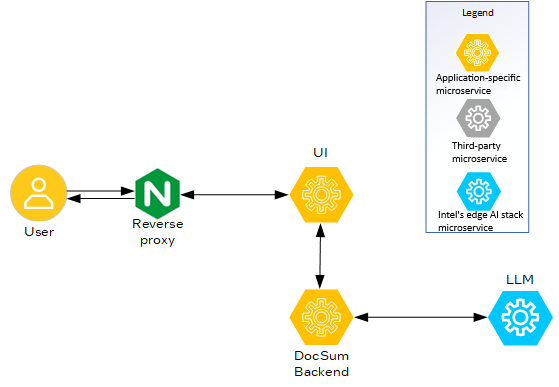
Components#
1. NGINX Web Server-based Reverse Proxy#
Role: Routes external requests to the appropriate backend service (API or UI).
Configuration:
nginx.confPort:
8101(external)
2. Gradio UI-based UI (docsum-ui)#
Role: Provides a web interface for users to upload documents and view summaries.
Implementation:
ui/gradio_app.pyPort:
9998(external, mapped to7860in container)Depends on:
docsum-api
3. DocSum Backend Platform (docsum-api)#
Role: Handles REST API requests for document summarization and file uploads; and orchestrates the summarization pipeline.
Implementation:
app/server.pyPort:
8090(external, mapped to 8000 in container)Depends on: OVMS Model Server (for LLM inference)
4. LLM on OpenVINO™ Model Server (ovms-service)#
Role: Serves AI models (e.g., LLMs) for inference.
Configuration: Loads models from a mounted volume.
Ports:
9300(gRPC),8300(REST)
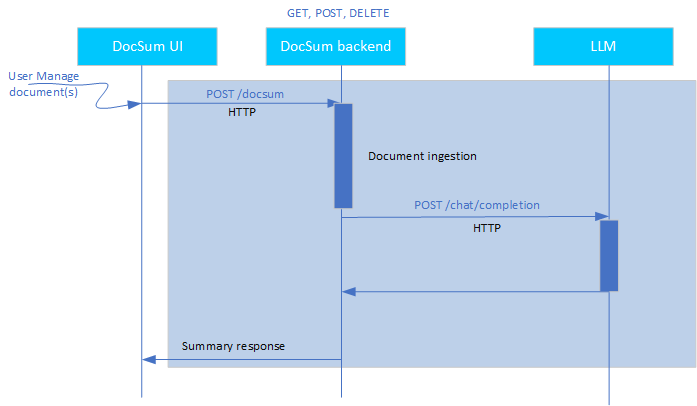
Data Flow#
User uploads a document through the UI.
UI sends the document to the DocSum backend platform (
docsum-api) through REST API.Backend processes the document (e.g., chunking and pre-processing).
Backend sends inference requests to the OpenVINO™ model server for summarization.
Summary is returned to the backend platform, which then sends it to the UI for display.
The following figure shows the data flow:
Deployment#
All services are containerized and orchestrated through
docker-compose.yaml.Services communicate over a shared Docker bridge network (
my_network).Environment variables are used for configuration and proxy settings.
Key Files#
docker-compose.yaml: Service orchestration.app/server.py: FastAPI backend.ui/gradio_app.py: Gradio UI.nginx.conf: NGINX web server configuration.
Extensibility#
Model Flexibility: OpenVINO™ model server can serve different models by updating the model volume and configuration.
UI Customization: Gradio UI provides rich set of capabilities to customize the UI as per user preferences.
API Expansion: You can extend the FastAPI backend for more endpoints or pre and post-processing logic.
Security and Observability#
Security: You can configure the NGINX web server for SSL and TLS authentication.
Logging: Each service logs to stdout and stderr for Docker log aggregation.
Healthchecks: OpenVINO™ model server and API services have healthchecks defined in Docker Compose tool.